
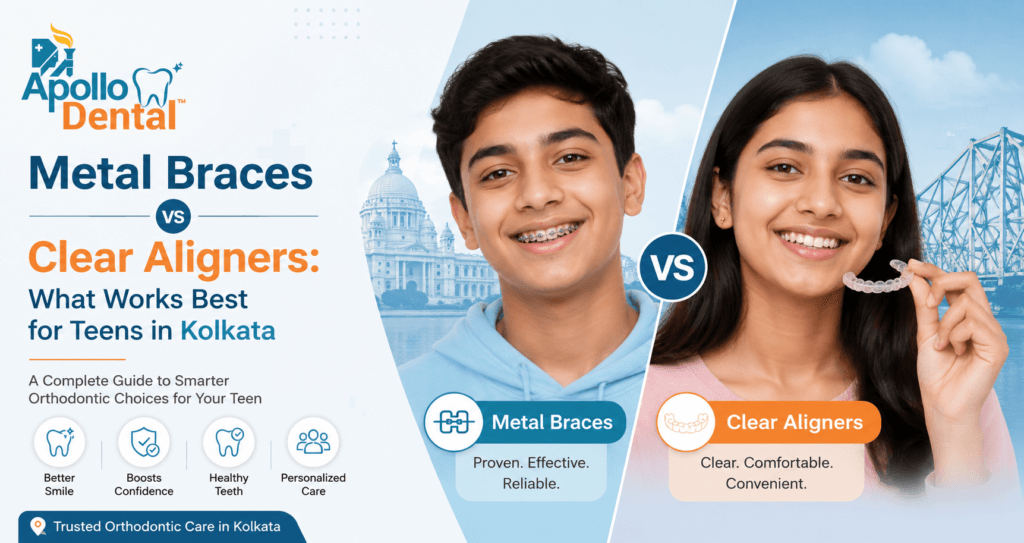
The most common disagreement between teens and parents at our clinic. The teen wants aligners. The parent wants metal braces or the other way around.
We see this constantly at Apollo Dental. The teen comes in, has clearly already decided, and the parent has a completely different opinion. Both have reasons. Some of those reasons are good. Some are based on assumptions about the other option that aren’t accurate.
Our job in that consultation is to redirect the conversation toward one question: what does this specific teenager’s mouth actually need, and which option gives that the best clinical outcome?
The preference matters, the compliance reality of that specific teenager matters more.
The Basic Difference
Metal braces are fixed, they go on and stay on until we remove them. The treatment works whether the teenager remembers to do anything or not. Every meal, every activity, every morning they wake up and would rather be anywhere else than thinking about their teeth, the braces are still there, still applying force, still working.
Clear aligners are removable; they need to be in the mouth for 20 to 22 hours every day. Out for eating or out for cleaning. Back in within minutes. Every day for the full duration of treatment.
This difference is the single most important factor in the metal braces vs clear aligners decision for teenagers. Not appearance, not comfort, compliance.
Metal Braces vs Clear Aligners: Clinical Differences
For complex cases, metal braces win. Multiple rotations, significant crowding that requires precise three-dimensional tooth control, bite corrections that need constant force. Metal handles these cases better than aligners currently do. We recommend metal braces at Apollo Dental for cases where the clinical complexity requires it regardless of the teen’s preference.
For mild to moderate cases, aligners can produce equivalent outcomes when worn correctly. A teenager with minor crowding and spacing who is genuinely going to wear the aligners as directed is a good aligner candidate. The same teenager who will leave them on the desk while playing cricket for three hours every afternoon is not.
The Compliance Reality in Kolkata
We’re being direct about something here that some clinics skip.
Aligner compliance in teenagers is genuinely variable. Some teenagers wear them religiously. Some don’t. The ones who don’t produce outcomes that take significantly longer than expected and cost more to complete. The parents who chose aligners because they were more convenient often find themselves back in the chair twelve months later asking why things haven’t moved as expected.
When parents ask us which to choose, one of our standard questions is: does your teenager regularly remember to do things they find inconvenient? Phone charging, homework, daily habits. It’s not a judgment. It’s a clinical predictor. The answer shapes our recommendation.
Aligners or Braces: Which Is Better for Adults?
Different conversation for adults. Adults generally have better compliance. They’ve made the decision themselves. They understand what they’re committing to. They don’t leave aligners in their locker.
For adults with mild to moderate alignment concerns, aligners are often an excellent choice. Removable for professional settings, social occasions, and eating. Less visible. Easier to clean teeth around. The compliance variable that complicates the teen conversation is less of a factor.
For adults with complex bite or alignment issues, metal braces or ceramic braces still produce more predictable clinical results. The question is the same as it is for teens: what does the clinical picture need?
Braces vs Aligners Pros and Cons
Metal braces: work for all complexity levels, no compliance variable, highly effective, more visible, some dietary restrictions, harder to clean around.
Clear aligners: nearly invisible, removable, easier to clean teeth, comfortable, only effective when worn consistently, work best for mild to moderate cases.
There is no winner, there is only the right choice for a specific patient’s clinical situation and compliance reality.
Tips for Parents Making This Decision
Have an honest conversation with the teenager about compliance before the consultation. A teenager who tells you they’ll definitely wear aligners during the consultation but won’t is going to cost significantly more time and money than metal braces would have.
Ask the orthodontist at Apollo Dental to explain specifically why they’re recommending one over the other for your child’s case. If the recommendation is aligners, ask what happens if compliance is inconsistent. The answer to that question tells you a lot.
Get the full case assessed before the decision is made. X-rays, photographs, study models. A recommendation without these is a guess.
FAQs:
Which is better, metal braces or clear aligners for teens?
Depends on the clinical case and the teenager’s compliance habits. Metal braces for complex cases and lower-compliance teenagers. Aligners for mild to moderate cases in teenagers who will genuinely wear them consistently.
Aligners or braces, which is better for adults?
Adults generally suit aligners well for mild to moderate cases because compliance is more reliable. Complex adult cases still benefit from the clinical control metal or ceramic braces provide.
What are the pros and cons of braces vs aligners?
Braces are effective across all complexities and require no compliance effort. Aligners are invisible and comfortable but only effective when worn. Both produce excellent results in the right patient for the right case.
The Decision That Affects Two Years of Treatment
Getting this choice right at the start matters more than most families realise.
The wrong choice doesn’t just mean slower treatment. It means more appointments, more adjustments, more cost, and sometimes starting over with a different approach.
Apollo Dental provides orthodontic assessment for teenagers and adults in Kolkata, with full case evaluation before any recommendation is made. If metal braces or clear aligners are being considered, that assessment is where the right answer for that specific patient gets established.
Read More: